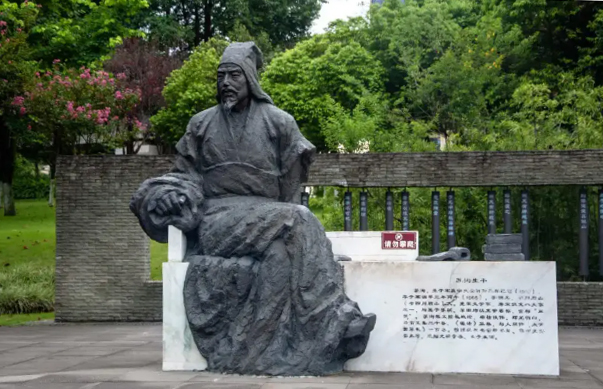
Su Xun
Introduction
Su Xun (1009–1066) was a prominent Chinese writer, philosopher, and scholar of the Northern Song Dynasty (960–1127). Alongside his sons, Su Shi and Su Zhe, he is celebrated as one of the "Three Sus" and is recognized as a member of the "Eight Great Prose Masters of the Tang and Song Dynasties." Su Xun is renowned for his exceptional contributions to classical Chinese prose and essays, which have left a lasting impact on Chinese literature and culture. His works, characterized by their clarity, depth, and philosophical insights, continue to be studied and admired by scholars and literary enthusiasts. Su Xun's life and legacy are closely tied to the city of Meishan in Sichuan province, where the ancestral home of the "Three Sus" has been preserved as a memorial temple.
Early Life and Education
Su Xun was born in 1009 in Meishan, a small city in Sichuan province, China. Unlike many of his contemporaries, Su Xun did not receive a formal education during his early years. Instead, he was largely self-taught, demonstrating an exceptional intellect and a deep passion for learning. It was not until his later years that Su Xun began to study the Confucian classics in earnest, driven by a desire to improve his understanding of philosophy, governance, and literature.
His determination to educate himself and his eventual mastery of classical texts were remarkable, especially considering the societal norms of the time, which placed significant emphasis on formal education. Su Xun's self-directed learning not only laid the foundation for his own literary achievements but also set an example for his two sons, Su Shi and Su Zhe, who would go on to become literary giants in their own right.
Career and Literary Contributions
Su Xun's career as a writer and scholar was marked by his ability to produce profound and eloquent prose. Although he did not hold a significant official position during his lifetime, his writings gained widespread recognition for their intellectual depth and stylistic elegance. Su Xun's essays often explored themes of morality, governance, and human nature, reflecting his deep engagement with Confucian philosophy.
Major Works
Among Su Xun's most celebrated works are his essays, which are considered masterpieces of classical Chinese literature. His writings are characterized by their logical structure, persuasive arguments, and clarity of expression. While specific titles of his essays are not as widely known as those of his son Su Shi, Su Xun's influence on the development of Chinese prose is undeniable. His works served as a model for later writers, who admired his ability to convey complex ideas with simplicity and precision.
Writing Style and Themes
Su Xun's writing style is notable for its straightforwardness and lucidity. He avoided the ornate and flowery language that was common in some literary circles of his time, instead favoring a more direct and unpretentious approach. This style not only made his works accessible to a broader audience but also ensured their enduring relevance.
Thematically, Su Xun's writings often delved into the principles of Confucianism, emphasizing the importance of moral integrity, filial piety, and good governance. His essays also reflected his philosophical musings on human nature and the complexities of life, offering readers timeless insights into the human condition.
Legacy and Influence
Su Xun's legacy is inseparable from that of his sons, Su Shi and Su Zhe, with whom he forms the celebrated trio known as the "Three Sus." Together, they are regarded as some of the greatest literary figures of the Northern Song Dynasty. Su Xun's emphasis on education and intellectual development had a profound impact on his sons, both of whom achieved remarkable success as writers, poets, and statesmen.
The influence of Su Xun and his family extends far beyond their lifetimes. Their works have been studied and revered for centuries, and they continue to be an integral part of Chinese literary and cultural heritage. The ancestral home of the "Three Sus" in Meishan has been preserved as a memorial temple, attracting visitors and scholars who come to pay homage to this extraordinary family.
Family and Personal Life
Su Xun was married to Madam Cheng, a well-educated woman who played a crucial role in the upbringing and education of their two sons, Su Shi and Su Zhe. Madam Cheng's dedication to her family and her contributions to the literary achievements of her sons have been increasingly recognized in recent years. Her story has been brought to life in the Chinese play "Su Mu (Su's Mother)", which highlights her life and her influence on the "Three Sus."
Su Xun's family life was deeply intertwined with his intellectual pursuits. His commitment to education and his philosophical outlook on life were values that he passed on to his sons, shaping them into the literary and cultural icons they would become. The family's legacy is celebrated not only in literary circles but also in popular culture, as evidenced by exhibitions, plays, and other tributes dedicated to their memory.
In summary, Su Xun's life and work represent a cornerstone of Chinese literary history. His contributions to prose and his role as the patriarch of the "Three Sus" have cemented his place as one of the most influential figures of the Northern Song Dynasty. His story, along with those of his family members, continues to inspire and educate new generations.








